ABioGram system
From antimicrobial susceptibility testing to therapy support
ABioGram validates antimicrobial susceptibility test results for inclusion in microbiology reports. Validated data help monitor antimicrobial resistance and update antimicrobial therapy protocols.
How ABioGram works
One validated result – two ways to use it.
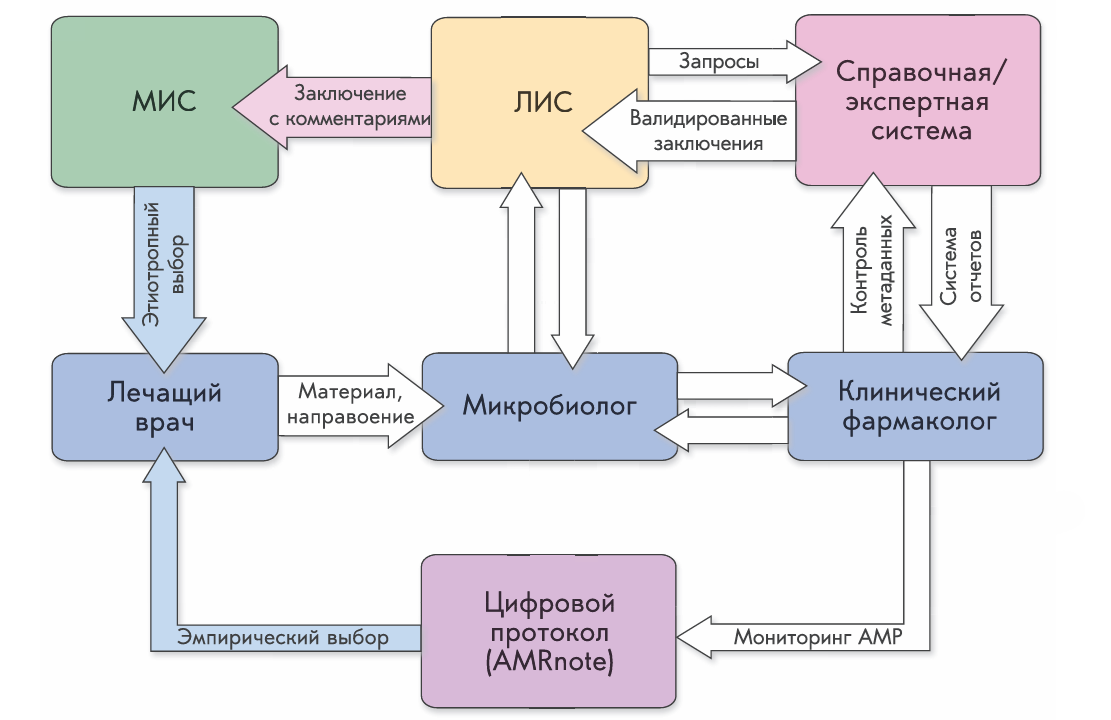
ABioGram – one workflow
Input
Susceptibility testing of an organism isolated from a patient
MIC · inhibition-zone diameter · S/I/R
Integrated expert assessment
Checking measurements and S/I/R, analyzing the antibiogram as a complete phenotype alongside available genotypic data.
Validated susceptibility result
For the individual patient
Microbiology report
The clinician uses the report with a validated susceptibility result when choosing pathogen-directed antimicrobial therapy.
For local practice
Etiology and AMR
Estimating the activity of agents and regimens informs empiric therapy approaches.
What the system does
ABioGram puts our domain expertise into software tools for the everyday work of healthcare organizations.
Expert validation
Validation of antimicrobial susceptibility results before they are used in clinical care.
- Validation of MICs and zone diameters, S/I/R categorization, and consistency checks.
- Analysis of the antibiogram as a complete phenotype; identification of unusual and contradictory results.
- Comparison of phenotype with genotypic data and resistance markers when available.
- Generation of a validated susceptibility result and relevant expert messages.
Microbiology surveillance
Local etiology and antimicrobial resistance data help healthcare leaders assess patterns across departments, organizations and periods.
- Pathogen distribution, susceptibility, resistance, phenotypes, and markers.
- Flexible analysis across any available data fields, including infection site, department, patient group and period.
- Period comparison, drill-down to source records, and patient test history where implemented.
- Surveillance at healthcare organization, network, or regional level.
Antimicrobial agent and regimen activity
Using local data to develop and update empiric antimicrobial therapy approaches.
- Estimation of activity probabilities for individual antimicrobial agents.
- Comparison of supported monotherapy and combination regimens.
- Assessment of therapeutic options in the context of pathogen etiology and susceptibility in the selected local population.
For clinical pharmacologists and the antimicrobial therapy team
Assessing empiric therapy options
ABioGram estimates the activity of agents and supported therapeutic regimens for a selected local pathogen population. These data help update local antimicrobial therapy protocols.
- 01
Define the analysis group
Infection site, department, patient group, period.
- 02
Estimate activity
Relate local etiology to antimicrobial susceptibility in that population.
- 03
Compare options
Individual agents, monotherapy and supported combinations.
The estimate describes microbiological activity in the selected population; it does not predict an individual patient’s clinical outcome.
Domain and methodological foundation
The domain expertise behind expert validation and interpretation of results.
Which guidelines and criteria are used?
Expert assessment draws on documents for different organism groups and test methods:
- Russian recommendations Determination of susceptibility of microorganisms to antimicrobial agents, version 2025-01.
- Russian recommendations Determination of susceptibility of microorganisms to antimicrobial agents, version 2026-01.
- EUCAST Breakpoint tables for interpretation of MICs and zone diameters for bacteria, versions 14.0–16.1.
- EUCAST Clinical breakpoints for fungi, version 12.1.
- EUCAST epidemiological cut-off values (ECOFFs).
- CLSI M100, Performance Standards for Antimicrobial Susceptibility Testing.
- CLSI M45, Methods for Antimicrobial Dilution and Disk Susceptibility Testing of Infrequently Isolated or Fastidious Bacteria.
- CLSI M27M44S, Performance Standards for Antifungal Susceptibility Testing of Yeasts, 4th ed. (2026).
- Other relevant documents and recommendations on susceptibility testing and interpretation of microbiology results.
What does expert result validation include?
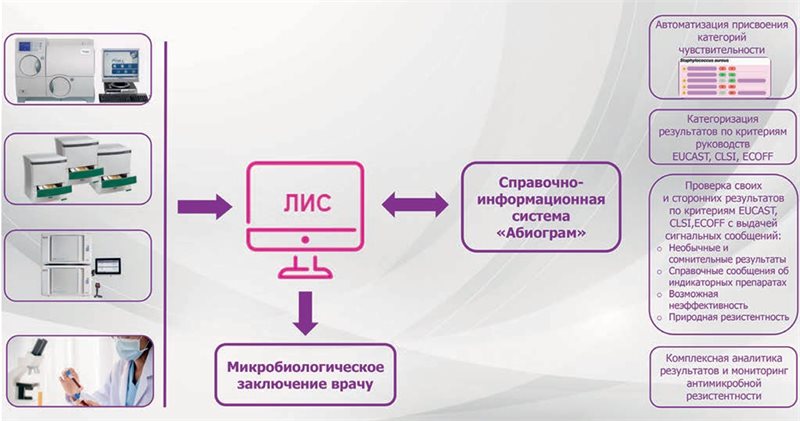
ABioGram checks MICs, inhibition-zone diameters and S/I/R categories, then evaluates the antibiogram as a complete phenotype. When genotypic data are available, the system compares them with the phenotype.
Expert assessment helps identify unusual and contradictory results and account for intrinsic resistance, indicator agents and limitations on use. The output is a validated result and relevant expert messages for the microbiology report.
LIS/HIS integration and web interface
These are two ways to provide test data to ABioGram and obtain a validated result. With LIS/HIS integration, the scope of data exchange depends on the deployment model.
API exchange
The system receives microbiology test data from LIS/HIS. After validation, it returns the susceptibility result and expert messages for use in the existing workflow.
Working in the web interface
A specialist enters test data and reviews the validated result directly in ABioGram. This approach does not require API data exchange with LIS/HIS.
AMR surveillance takes place in the ABioGram interface; when integrated, an individual test result is returned to LIS/HIS. In a network-wide deployment, multiple healthcare organizations can connect to the system.
Technical capabilities
Deployment, scaling, support, and operating conditions.
Deployment, scaling, and information security
Support and licensing
Reference implementation models
Regional healthcare system
Automated validation of microbiology reports and real-time AMR surveillance across healthcare organizations in the region.
National Medical Research Center
Result validation, exchange of validated data, and continuous analytics within a medical center.
Russia’s largest microbiology laboratory
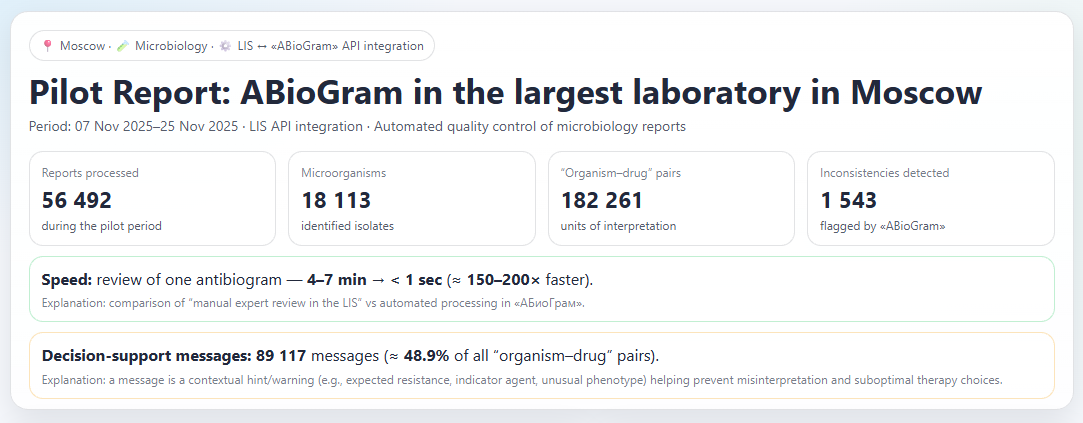
56.5 thousand reports in three weeks: automated categorization, error detection, and online microbiology surveillance.
Laboratory of a major infectious diseases hospital
A centralized bacteriology laboratory as a source of validated data for clinical and epidemiological use.
Publications and evidence base
Scientific materials support the approaches to microbiology data quality, surveillance methodology, local etiology and AMR analysis, and the use of data in antimicrobial therapy.
Local AMR Monitoring in Healthcare Facilities: What Guidelines Agree On–and Where They Diverge
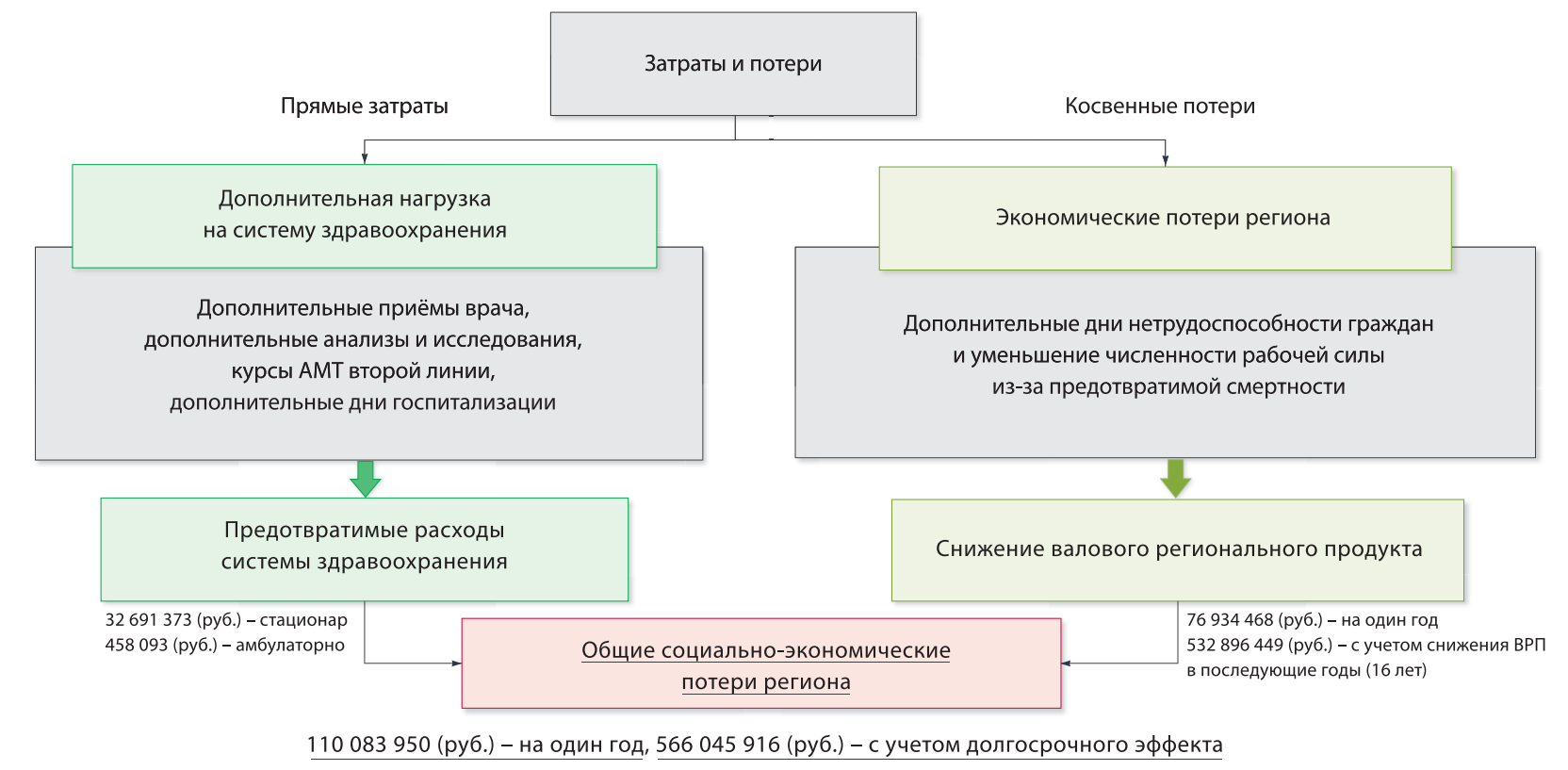
How Much Do Microbiology Errors Cost? An Economic Loss Model for Incorrect AMR Diagnostics and Irrational Antimicrobial Therapy
ABioGram Implementation Case: A Closed Digital AMR Surveillance Loop. How to Move from Manual Reports to Validated Data and Real-Time Analytics
Yamalo-Nenets Autonomous Okrug Experience: A Regional System for Automated Validation of Microbiology Reports and Real-Time AMR surveillance
The product’s official name is the ABioGram reference and information system.
Additional information about ABioGram
Upon request, we provide information about system capabilities, deployment options, and LIS/HIS integration.