Centralized Microbiology Laboratory as an Information Hub: from “Export-Based surveillance” to Next-Generation AMR surveillance with ABioGram
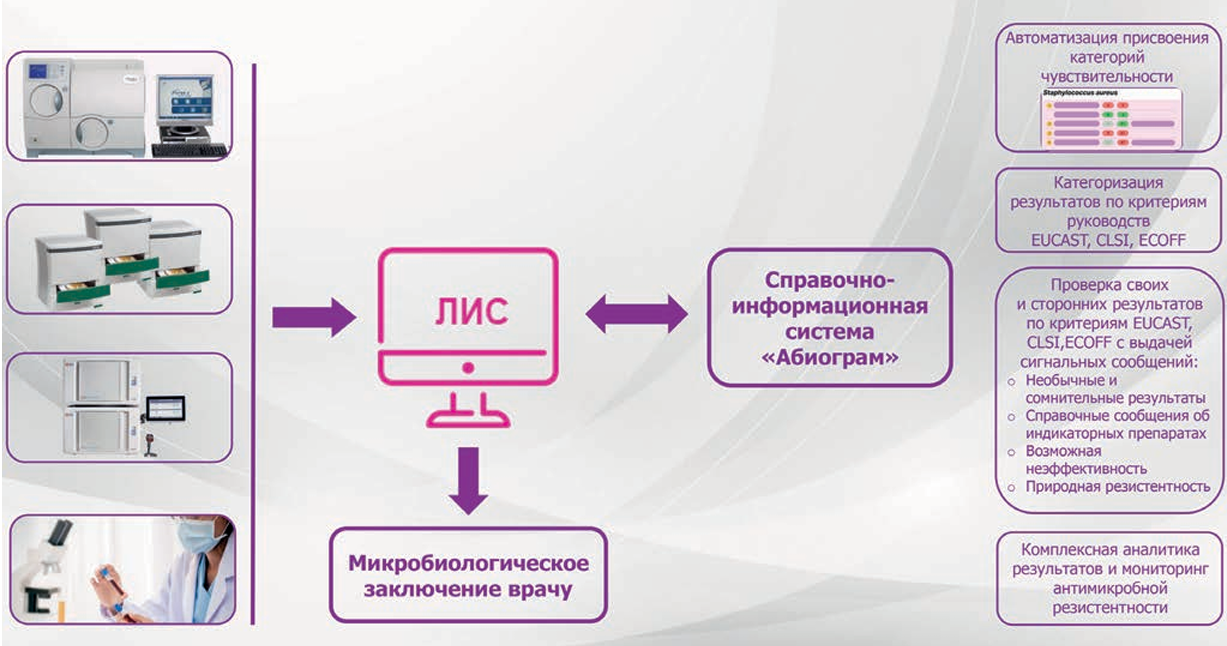
Table of Contents
Publication details
Title: “Centralized Microbiology Laboratory as an Information Hub”
Author: S.A. Gordeeva
Journal: Poliklinika, No. 4(1), 2024 (special issue No. 20), pp. 11–15
The article shows how a centralized bacteriology laboratory can become an information hub in a high-throughput setting: data from analyzers, the LIS, and supporting services are converted into a validated microbiology report and manageable antimicrobial resistance (AMR) surveillance.
A key message for AMR surveillance practice is the shift from “first-generation” local surveillance (external analytics plus regular exports) toward next-generation surveillance with ABioGram, where interpretation quality control and surveillance are built into the live workflow on the basis of automatically validated microbiology reports.
Download
- PDF (Poliklinika journal):
⬇️ Download the article (PDF)
Why this matters
In microbiology, the bottleneck is often not the analyzer – it is interpretation and reporting:
- interpretation criteria and reference data are updated regularly;
- instruments and software modules may apply different logic;
- the risk of errors increases at scale;
- clinicians need clearer, more actionable explanations in the report.
As a result, AMR surveillance and updates to local empiric therapy guidance often degrade into manual “summary reports” that do not scale.
Case context: high throughput and a centralized model
The centralized bacteriology lab at Botkin Hospital (Saint Petersburg) provides services to 70+ medical organizations.
Daily volume includes 1,500–2,000 samples, 500–1,000 identification tests, and 300–400 antimicrobial susceptibility tests.
To convert such volumes into usable, auditable data, an IT architecture is required: an LIS as the “backbone”, analyzer integrations, quality control, transparent logistics, and digital delivery of results to clinicians.
Core IT stack: the LIS as the laboratory “nervous system”
The article describes the LIS role as enabling:
- automation of routine steps,
- centralized data governance,
- error minimization,
- faster delivery of results to clinicians,
- reporting and analysis.
It also highlights integrations (including delivery of validated results to clinical systems and analytics exports), as well as quality control functions and tools for managing laboratory operations (e.g., task journals for lab staff).
“First-generation” local surveillance: analytics platform + exports
The article references AMRcloud as an example of a platform used for local AMR surveillance:
- visualization and filters,
- report/presentation generation,
- support for building/updating empiric antimicrobial therapy protocols,
- data exchange.
In practice, this approach often relies on routine data exports and manual data preparation, and therefore quickly hits limits in terms of workload, data quality, and timeliness. As a result, the labor required to run surveillance this way in real-world settings is often underestimated.
Why “getting the report right” is hard at scale
The article lists common obstacles:
- different interpretation rules across instruments/software,
- the need to update guidance regularly,
- increasing error risk at high throughput,
- taxonomic changes,
- the need to verify expert rules before releasing results,
- insufficient explanatory content for clinicians in the report.
Bottom line: reliable reporting requires maintained, up-to-date rules and expert logic that accounts for context (organism-specific patterns, intrinsic resistance, internal consistency checks, etc.).
Moving to next-generation surveillance – ABioGram
To address interpretation quality and make surveillance truly continuous, the article describes a new tool – the reference-information system “ABioGram”.
What ABioGram does in the live workflow
- Automates interpretation (categorization) of antimicrobial susceptibility results and report checks.
- Provides system-level AMR surveillance within the organization: interactive analytics, alerts, and error tracking.
- Integrates with the LIS/clinical systems (or can run as a standalone solution).
A key idea in the article is that ABioGram works as a “reference-information filter” before releasing the microbiology report.
It also supports clinician-facing comments generated from automated checks for each organism – improving the clinical readability of results, especially for difficult resistant pathogens.
What changes specifically in surveillance
If local surveillance previously relied on an external analytics platform and data exports, then with seamless integration:
- ABioGram reduces the need for routine export/curation work for local surveillance, and
- moves surveillance toward real-time operation, driven by automatically validated microbiology reports.
The article frames this as next-generation surveillance: higher report quality and interpretability plus continuous AMR surveillance from the same data stream – without a disconnect between “diagnostics” and “analytics”.
Before/after: the operating logic (brief)
| Topic | Previously (typical) | Next-generation flow with ABioGram |
|---|---|---|
| Report quality foundation | Manual expert review + fragmented criteria | Automated rule-based checks + consistent interpretation logic |
| AMR surveillance | Separate process, often export-based | Built-in process: surveillance from automatically validated reports |
| Speed and scalability | More labor as volume grows | Less routine work; scales with high throughput |
| Clinician usefulness | Often only susceptibility categories | Report comments and explanations to support decisions |
Key takeaways (executive view)
- Large, centralized microbiology operations cannot be managed efficiently without dedicated IT.
- LIS-driven automation delivers major gains in productivity.
- End-to-end integration and logistics enable high volumes without proportional growth in staff and physical capacity.
- Adopting the next-generation system ABioGram:
- reduces report turnaround time by ~1.5–2×,
- improves the clinical interpretability of the report,
- and automates AMR surveillance.
Practical conclusion
Moving to next-generation surveillance is not “one more report”.
It is an architectural shift: a validated microbiology report is produced in the live workflow, and real-time AMR surveillance is built automatically from the same stream.
This is how microbiology evolves from “producing results” into a controllable, auditable information pipeline for clinical and managerial decision-making.
Related materials
NMRC LRC: A Closed Digital AMR Surveillance Loop
Review of a CMAC (2025) publication: implementation of an integrated digital loop (LIS–ABioGram–HIS), automated antibiogram validation, continuous AMR surveillance, and the impact of expert comments on clinical decision-making.
OpenLocal AMR Surveillance: Comparing Guidelines
A review from CMAC (2025) compares WHO GLASS, CLSI M39, ESCMID, AMRcloud guidance and Russian MR 3.1.0346-24–highlighting key contradictions that matter for local antibiograms, data quality, and stewardship decisions.
OpenABioGram system
Validation of susceptibility results for isolated organisms, analysis of local etiology and AMR, and assessment of antimicrobial agent and regimen activity.
Open