ABioGram Implementation Case: A Closed Digital AMR Surveillance Loop. How to Move from Manual Reports to Validated Data and Real-Time Analytics
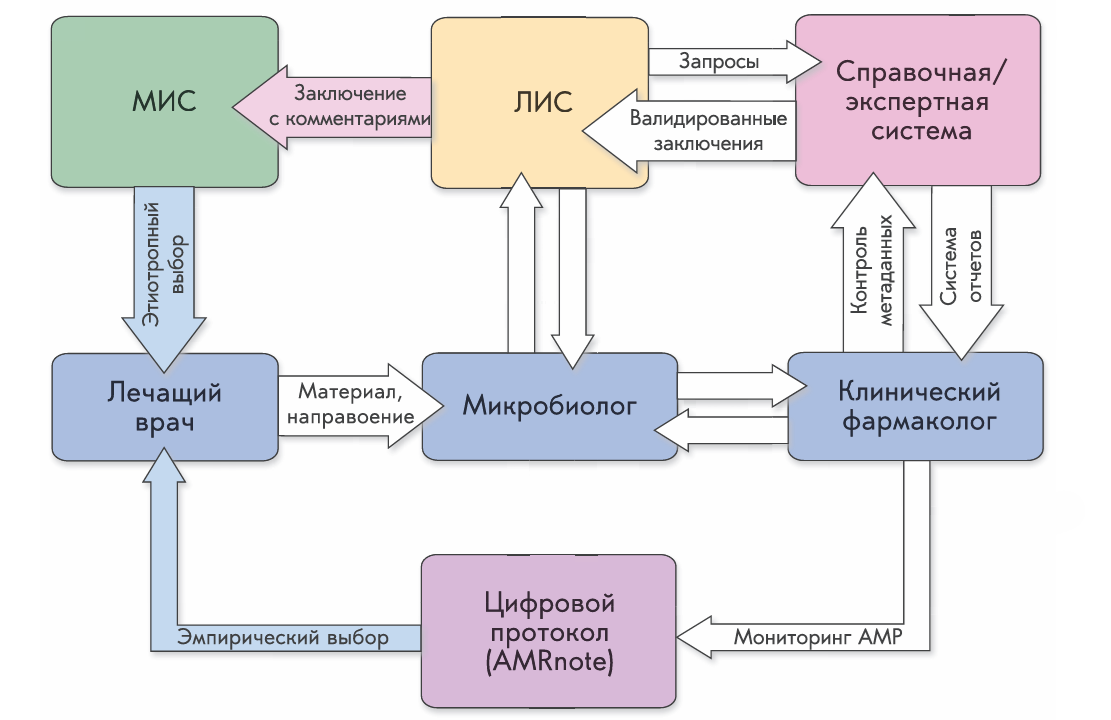
Table of Contents
Publication overview
Title: “Experience in creating a closed digital loop to ensure continuous antimicrobial resistance monitoring based on validated microbiological diagnostic results”
Authors: Gultyaeva N.A., Vinogradova A.G., Kolesnikova I.V., Ryzhova K.A., Shelkovnikova O.V.
Journal: Clinical Microbiology and Antimicrobial Chemotherapy (CMAC), 2025, Vol. 27, No. 3, pp. 369–389
DOI: 10.36488/cmac.2025.3.369-389
The publication describes a real-world implementation case in which a microbiology service was re-engineered into a closed digital loop: from specimen registration and standardized antimicrobial susceptibility testing to a validated final report, accumulation of structured data (including metadata), and continuous AMR analytics to support local empiric antimicrobial therapy (EAT) protocols.
Download
- Article PDF:
⬇️ Download the article (PDF)
How to cite
Gultyaeva N.A., Vinogradova A.G., Kolesnikova I.V., Ryzhova K.A., Shelkovnikova O.V. Experience in creating a closed digital loop to ensure continuous antimicrobial resistance monitoring based on validated microbiological diagnostic results. CMAC. 2025;27(3):369–389. DOI: 10.36488/cmac.2025.3.369-389
Why this matters
In most healthcare organizations, the bottleneck is the same: microbiology data exist, but they are:
- fragmented (different logs, LISs, formats),
- dependent on manual curation,
- poorly reusable for surveillance and updating local guidelines.
The key outcome of this project is the transition from episodic, manual AMR surveillance to continuous, real-time digital analytics based on validated data. The foundation of this process and the fundamental data unit is the digital microbiological report. It is generated automatically based on continuously updated criteria and contains structured comments that explain the interpretation of the result.
Objective, design, and what was implemented
Objective: to implement a closed digital loop for continuous AMR surveillance based on validated microbiological diagnostic results.
Study period: May 2024 – September 2025 (prospective study).
Implementation steps:
- Audit of the baseline state and SWOT analysis.
- Software and data flow restructuring, process optimization.
- Standardization of methods in accordance with EUCAST recommendations.
- Implementation of an integrated system: LIS (with a microbiology module) + ABioGram.
What a “closed digital loop” means in this case
The loop is not simply “sending results to the HIS”. It is a cycle in which:
- microbiology → generates data and a request to the ABioGram,
- the microbiologist → validates results and produces the final report,
- the system → accumulates data and metadata and builds analytical reports,
- reports → are used to update local empiric antimicrobial therapy protocols (accessible to clinicians),
- the outputs of the loop are a validated report with expert comments and an empiric therapy protocol.
(The loop diagram is shown in Figure 13 of the article.)
A key building block: metadata and field standardization
The authors emphasize the importance of metadata fields for data exchange between the LIS and the ABioGram (Table 3), including: patient/sample ID, age, sex, ward, test purpose (diagnostic vs screening), clinical features (e.g., “>3 days in ICU”), infection diagnosis, and others.
These fields underpin the user interface filters (Figure 2), which generate analytical cohorts (by date, purpose, diagnosis, ward, etc.) and enable both basic descriptive analyses and multifactorial analyses to identify correlations.
Implementation results: what actually changed
1) Automation and validation of antibiograms
ABioGram implementation enabled:
- automated expert assessment and validation of antibiograms,
- a continuous flow of structured data (including metadata),
- transition to real-time AMR surveillance and analysis.
2) Prospective surveillance without manual “data cleaning”
The authors demonstrate prospective AMR surveillance without the need for constant manual data correction–achieved through standardized data entry, mandatory metadata, and digital validation.
3) Multifactorial analysis: resistance plus risk factors
A multifactorial analysis was demonstrated to identify correlations between resistance patterns of key pathogens and patient- and context-level risk factor metadata.
4) Expert comments in reports–and how clinicians perceived them
A key feature of the new report format is the automatic assignment and reporting of expert comments by the ABioGram, based on up-to-date EUCAST/CLSI criteria and a library of expert rules.
Examples of comment types provided by the authors include:
- Susceptibility adjustment based on an indicator agent
- Uncertain therapeutic efficacy
- Warning of expected resistance
- Warning of resistance development risk
- Warning of a rare phenotype
- Result extrapolation
Clinician survey results:
- 89.4% notice and read the expert comments;
- 91.5% believe the comments help in selecting an antibiotic when consultation is unavailable;
- 53.2% rated the comments as clear (8–10 points on a 10-point scale), while another 27.7% noted that explanations are sometimes needed.
“Before/after” in one table: process changes
The article includes a comparative table of microbiological diagnostics and AMR surveillance before and after implementation (Table 4).
“Before” examples include paper logs, handwritten requests with minimal data, separate accounting for inpatient and outpatient samples, outdated software, and manual result entry.
“After” implementation, this shifted to digital order entry in LIS/HIS, a digital workflow log of laboratory stages, enriched electronic requests with structured fields, and automatic metadata transfer.
What ABioGram Enabled: Summary Table
| Area | Typical “Before” State | What ABioGram Enabled (within the LIS–ABioGram–HIS digital loop) | Practical Impact |
|---|---|---|---|
| Antibiogram validation | Manual expert review; variability in interpretation; delays | Automated expert assessment and validation of antibiograms based on rule-based logic and current interpretation criteria | Fewer errors and delays; consistent conclusions |
| Unified rules and standards | Different approaches across staff and shifts; hard to control versions | Centralized interpretation and comment rules, with controlled updates (EUCAST/CLSI-based logic embedded in rules) | Stable quality and reproducibility of decisions |
| Metadata and structuring | Minimal fields; free text; handwritten forms; limited reuse | Introduction and use of standardized metadata fields (purpose, ward, diagnosis, risk factors, etc.) with reliable transfer between systems | Analytics becomes clinically meaningful, not just “S/I/R” |
| Continuous AMR surveillance | Episodic, manual summaries; delayed reporting | Continuous flow of validated data into the analytics layer with real-time AMR surveillance | Faster detection of trends and resistance changes |
| Segmentation and cohorts | Difficult separation of inpatient/outpatient, wards, diagnoses; heavy manual work | Flexible filters and cohort building by date, purpose, diagnosis, ward, etc., for descriptive and advanced analyses | Rapid analytics tailored to clinical scenarios |
| Multifactorial analysis (AMR + risk factors) | Mostly simple percentages; correlations rarely explored | Multifactorial analysis linking resistance patterns with patient and contextual risk factors via metadata | More precise local recommendations and targeted interventions |
| Expert comments in reports | Non-standardized, person-dependent comments | Automatic assignment and display of expert comments (indicator-based correction, warnings, extrapolation, etc.) | Point-of-care clinical decision support, especially without consultation |
| Clinician communication | “Raw” results with limited interpretability | Reports redesigned to be more clinically interpretable through standardized comments and rules | Higher trust and usability of microbiology results |
| Reports and local protocol updates | Infrequent, manual updates with limited transparency | A data-driven loop where analytics are used to regularly update local empiric antimicrobial therapy protocols | Protocols grounded in local, validated data |
| Digital traceability and process control | Paper logs and spreadsheets; limited auditability | End-to-end digital workflow from order entry to validated report and secondary data use | Better governance, auditability, and data quality |
Bottom line: When implemented as part of an integrated digital loop, ABioGram transforms microbiology from a “results factory” into a sustainable source of validated data and real-time analytics, directly supporting local empiric antimicrobial therapy decisions.
Practical takeaway for management, department heads, and stewardship teams
The core message of the case can be summarized as follows:
Everything begins with the digital microbiological report and its explanatory comments, which serve as the primary structured data unit. AMR surveillance becomes sustainable only when this data is validated, structured, and automatically fed into the analytical pipeline. Consequently, the microbiology service shifts away from being a mere “results production line” and evolves into a central hub of expertise and data for local decision-making regarding both empirical and targeted antimicrobial therapy.
Related materials
YNAO: A Regional AMR Surveillance System
A review of the 2025 CMAC publication: the experience of the Yamalo-Nenets Autonomous Okrug in implementing a regional system for automated validation of microbiology reports, continuous AMR surveillance, and real-time analytics.
OpenThe Cost of Errors in Microbiology
How susceptibility testing accuracy, prescribing errors, and AMR diagnostics translate into measurable economic losses–and why even a 10% error rate can cost millions of rubles.
OpenABioGram system
Validation of susceptibility results for isolated organisms, analysis of local etiology and AMR, and assessment of antimicrobial agent and regimen activity.
Open