ABioGram Implementation in the largest laboratory in Moscow: the Pilot Demonstrated 150–200× Faster Review and Detection of Inconsistencies in Microbiology Reports
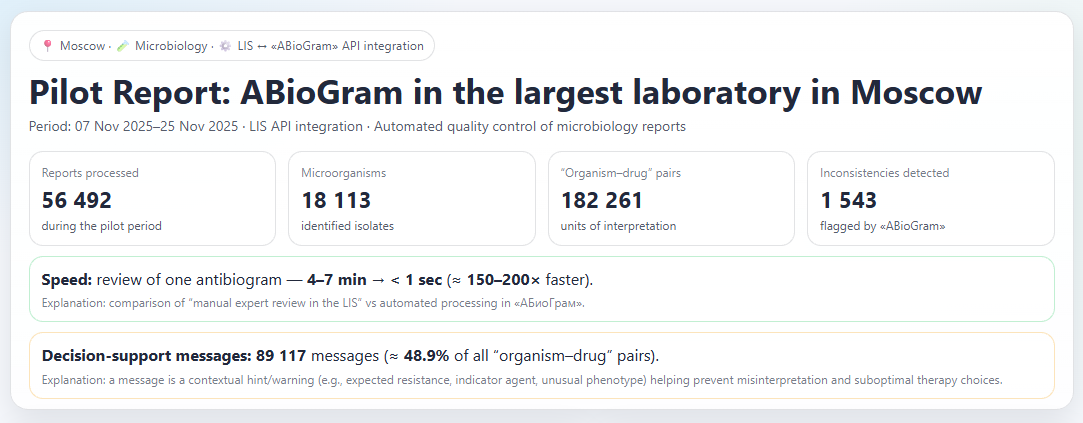
Table of Contents
Context: where and why the pilot was conducted
The pilot of the ABioGram reference-information system was conducted in the largest laboratory in Moscow during 07 Nov 2025 – 25 Nov 2025. The goal was to assess the system’s effectiveness for automated interpretation of antimicrobial susceptibility results and quality control of microbiology reports.
What was implemented (technology and operations)
Technology: the system was deployed on the organization’s local server. Integration with the LIS was implemented via API: the LIS sent data for interpretation, while ABioGram returned interpreted results and decision-support messages.
Operations: staff received onboarding; the test environment included data entry for antibiograms, receiving interpreted conclusions, reviewing decision-support messages, and evaluating analytical modules.
Data volume processed
During the pilot period, the system processed:
- 56,492 microbiology reports;
- 18,113 identified microorganisms;
- 182,261 “microorganism–antimicrobial agent” combinations.
Key pilot results (numbers)
Summary metrics table
| Metric | LIS | ABioGram |
|---|---|---|
| Number of reports | 56,492 | 56,492 |
| Reports with microorganisms and antimicrobial agents | 18,113 | 18,113 |
| “Microorganism–antimicrobial agent” combinations | 182,261 | 182,261 |
| Detected errors / inconsistencies | 0 | 1,543 |
| Automatically generated decision-support messages | – | 89,117 |
| Potentially incorrect therapy choices flagged | 0% | 48.9% (89,117 / 182,261) |
What typically “breaks” in standard LIS logic
The report highlights inconsistencies typically seen with an LIS-only workflow:
- limited flexibility to maintain up-to-date interpretation criteria (EUCAST/CLSI/Russian guidance);
- lack of intrinsic (natural) resistance handling and insufficient data accumulation for further assessment;
- no warnings about potential lack of efficacy.
In contrast, ABioGram correctly applied current criteria (Russian guidance; EUCAST/CLSI), generated warnings about expected resistance, showed decision-support messages/indicator agents, and flagged unusual or contradictory results.
Speed: 150–200× faster review
Time comparison (LIS with manual review vs ABioGram):
- review of one antibiogram: 4–7 minutes → < 1 second;
- a series of 20 tests: 120 minutes → 20–25 seconds;
- preparation of the final conclusion: 2–3 minutes → < 1 second (as part of total processing).
The report concludes that the overall processing time was reduced by more than 150–200× compared with LIS plus manual expert verification.
What the system delivered (functionality and workload)
The report notes:
- correct interpretation according to current guidance (2024–2025);
- automated detection of errors;
- real-time AMR analytics;
- data export.
It also documents an approximate 85–90% reduction in review time, fewer errors, and reduced routine workload for laboratory staff.
Impact: economic, clinical, and managerial
Economic impact: by reducing the probability of potentially inappropriate empiric antimicrobial therapy decisions (e.g., from ~15% to ~5%), the system can lower hospitalization/treatment costs, improve antimicrobial use quality, and prevent losses from readmissions and prolonged treatment.
Clinical impact: improved data quality for targeted therapy selection, timely identification of resistant isolates, and higher-quality microbiology reporting.
Managerial impact: reliable data for surveillance, analytical dashboards for resistance trend tracking, and structured primary data to support updates of local empiric therapy protocols.
Conclusion and recommendation
The pilot was considered successful. The report emphasizes that ABioGram improves the accuracy of microbiology reports, reduces labor costs and the probability of errors, and enables real-time AMR surveillance.
Expected outcomes include:
- 48.9% reduction in the probability of potentially suboptimal antimicrobial therapy decisions via decision-support messages;
- reduced staff workload and workflow standardization;
- minimized errors in antimicrobial susceptibility reporting;
- consistent use of current standards (critical when imported instrument software cannot be updated quickly);
- stronger justification for high-cost therapy regimens;
- real-time AMR surveillance (including to support empiric therapy).
Recommendation: the system is recommended for permanent deployment as a tool for automated interpretation of antimicrobial susceptibility results and AMR surveillance.
Related materials
NMRC LRC: A Closed Digital AMR Surveillance Loop
Review of a CMAC (2025) publication: implementation of an integrated digital loop (LIS–ABioGram–HIS), automated antibiogram validation, continuous AMR surveillance, and the impact of expert comments on clinical decision-making.
OpenThe Cost of Errors in Microbiology
How susceptibility testing accuracy, prescribing errors, and AMR diagnostics translate into measurable economic losses–and why even a 10% error rate can cost millions of rubles.
OpenABioGram system
Validation of susceptibility results for isolated organisms, analysis of local etiology and AMR, and assessment of antimicrobial agent and regimen activity.
Open