How Much Do Microbiology Errors Cost? An Economic Loss Model for Incorrect AMR Diagnostics and Irrational Antimicrobial Therapy
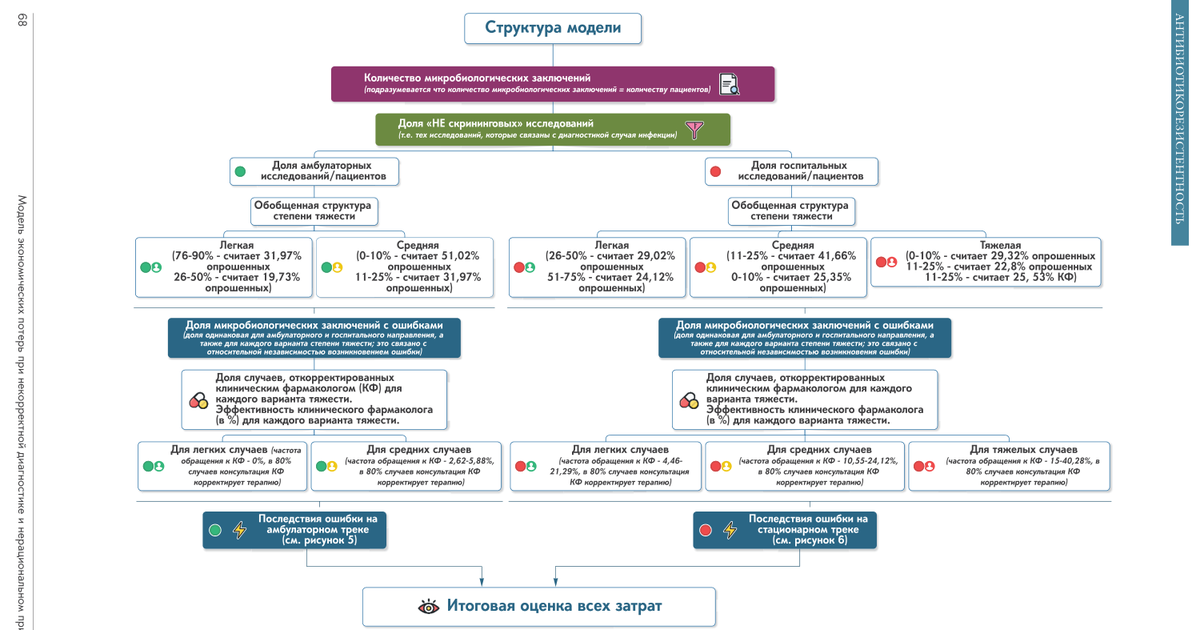
Table of Contents
Overview
Title: “A model of economic losses due to incorrect microbiological diagnosis of antimicrobial resistance and irrational use of antimicrobials”
Authors: Kuzmenkov A.Yu., Vinogradova A.G., Gultyaeva N.A., Svyato O.P.
Journal: Clinical Microbiology and Antimicrobial Chemotherapy (CMAC), 2025, Vol. 27(1), pp. 54–72
DOI: 10.36488/cmac.2025.1.54-72
This CMAC (2025) paper proposes an adaptable economic model that links: microbiology report accuracy → probability of irrational antimicrobial therapy (AMT) → clinical outcomes → direct and socio-economic losses.
In the demonstration scenario (1,000 reports, 10% probability of error, 70% inpatient / 30% outpatient), the model yields:
- ₽1,756,226 in direct inpatient costs (per year);
- ₽2,743,957 in total annual losses (direct + socio-economic; excluding “value of life” and excluding YLL discounting);
- up to ₽18,943,957 in total losses under the “value of life (CEMI RAS)” scenario.
Note: Monetary values are reported in Russian rubles (₽) as presented in the paper.
Download
Article PDF:
⬇️ Download the article (PDF)Supplementary materials (model/data): ⬇️ Download zip archive
How to cite
Kuzmenkov AYu, Vinogradova AG, Gultyaeva NA, Svyato OP. A model for estimating economic loss attributable to incorrect microbiological diagnosis of antimicrobial resistance and irrational antimicrobial use. Clinical Microbiology and Antimicrobial Chemotherapy. 2025;27(1):54–72. DOI: 10.36488/cmac.2025.1.54-72
Why this model matters in practice
Errors in interpreting AST results–and the AMT decisions that follow–are not only clinical risks, but also measurable economic damage, including:
- additional hospital days and procedures;
- higher treatment costs (e.g., escalation to “second-line” options);
- productivity losses due to temporary disability;
- losses from premature mortality (via Years of Life Lost, YLL) or via a “value of life” approach.
This model is useful when you need to:
- justify a management decision (e.g., digitalizing AST interpretation, quality audits, clinical pharmacology stewardship workflows);
- compare scenarios (how losses change when the error rate drops from 20% to 10%);
- prioritize interventions (where ROI is higher: training, QC, case reviews, validation rules, etc.).
What the authors did: data and methodology
The authors collected baseline parameters using a survey focused on AMT practice, error frequency and consequences, the role of microbiological testing, and consultation workflows.
Below are selected survey findings (used as context and inputs before building the model):
| Indicator | Value (from the paper) | Why it matters |
|---|---|---|
| Share of specialists regularly dealing with bacterial infections | >75% | AST quality affects routine practice, not rare edge cases |
| Share receiving AST reports as an electronic document in the hospital IS | 50.85% | Digital format = faster, auditable, enabling automated checks |
| Share receiving results from an in-house laboratory | 65.62% | Provides a foundation for local QC and rule-based validation |
| Share without access to laboratory consultation | 36% | Higher risk of misinterpretation and inconsistent decisions |
| Share noting a direct link between AST results and AMT choice | 82.32% | AST report is a real tool that influences antimicrobial therapy in most cases. |
| Severe consequences of incorrect AMT in the inpatient setting (>25% of cases) | 19.52% of respondents | Indicates substantial clinical and economic risk |
The model framework then incorporates:
- Two care pathways
- outpatient
- inpatient
Severity strata (reflecting the distribution of clinical situations)
Share of microbiology reports with errors
- the key scenario parameter
- Clinical pharmacologist effect
- probability of consultation
- probability of therapy change following consultation
- Error consequences
- outpatient: minor/moderate
- inpatient: moderate/severe
- Cost estimation
- short-term: direct medical costs + socio-economic losses (e.g., GRP losses due to disability)
- long-term: YLL approach (with discounting) or a “value of life (CEMI RAS)” scenario
How the model works (in plain terms)
The model starts with the number of microbiology reports that are actually used to guide AMT (simplification: 1 patient = 1 report). It then allocates the population by pathway, severity, probability of error, stewardship/clinical pharmacology influence, and resulting consequences–producing annual loss estimates.
Demonstration calculation: 1,000 reports and a 10% error rate
Scenario assumptions:
- 1,000 microbiology reports used to guide AMT
- 70% inpatient / 30% outpatient
- probability of error: 10%
Table: estimated losses (as reported in the paper)
| Metric | Economic impact |
|---|---|
| Direct costs (inpatient pathway), per year | ₽1,756,226 |
| Socio-economic losses (inpatient pathway), per year | ₽866,830 |
| Direct costs (outpatient pathway), per year | ₽10,000 |
| Socio-economic losses (outpatient pathway), per year | ₽110,901 |
| Socio-economic losses (inpatient) incl. YLL and discounting | ₽7,701,159 |
| Socio-economic losses using “value of life” (CEMI RAS) | ₽17,066,830 |
| Total losses (per year) | ₽2,743,957 |
| Total losses (YLL + discounting) | ₽9,578,286 |
| Total losses (“value of life”, CEMI RAS) | ₽18,943,957 |
What you can do now to reduce losses
- Standardize AST interpretation (unified rules; strict version control for guidelines and knowledge bases).
- Improve microbiology report quality (structured templates, mandatory fields, contradiction checks).
- Make interpretation auditable (decision logging, error review, reference cases).
- Build a consultation workflow (microbiologist ↔ clinical pharmacologist ↔ treating physician).
- Measure impact (error rate, time-to-therapy-correction, escalation/de-escalation share, modeled economic effect).
Related materials
NMRC LRC: A Closed Digital AMR Surveillance Loop
Review of a CMAC (2025) publication: implementation of an integrated digital loop (LIS–ABioGram–HIS), automated antibiogram validation, continuous AMR surveillance, and the impact of expert comments on clinical decision-making.
OpenMoscow’s Largest Laboratory: Faster Result Validation
Pilot results in the largest laboratory in Moscow (07 Nov–25 Nov 2025): API integration with the laboratory information system, automated interpretation of antimicrobial susceptibility results, 89,117 decision-support messages, and real-time AMR analytics.
OpenABioGram system
Validation of susceptibility results for isolated organisms, analysis of local etiology and AMR, and assessment of antimicrobial agent and regimen activity.
Open