Local AMR Monitoring in Healthcare Facilities: What Guidelines Agree On–and Where They Diverge
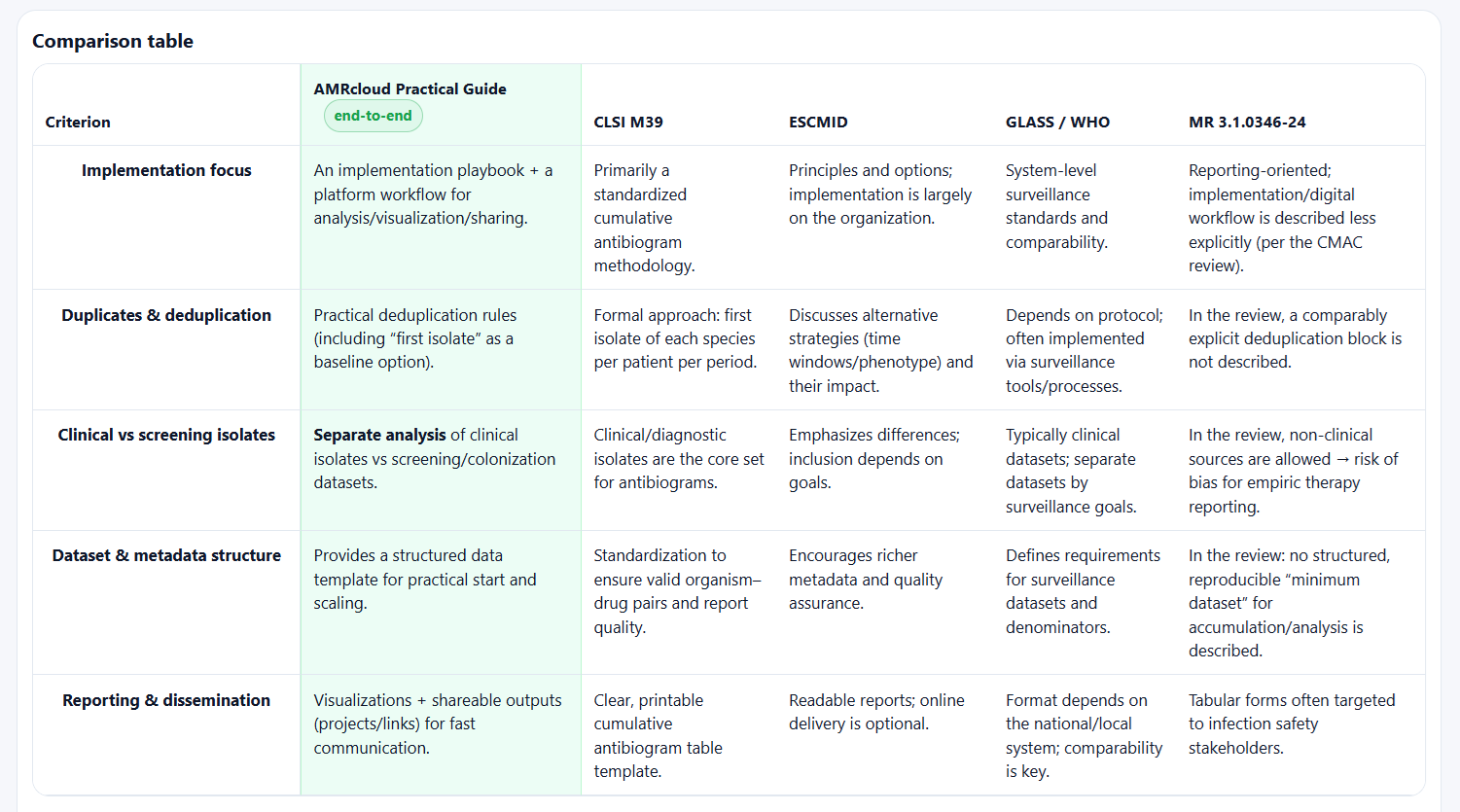
Table of Contents
Overview
Paper: Comparative analysis of antimicrobial resistance monitoring methodologies at the local healthcare level
Authors: N.A. Gultyaeva, A.G. Vinogradova, A.Yu. Kuzmenkov
Journal: Clinical Microbiology and Antimicrobial Chemotherapy (CMAC), 2025, Vol. 27, No. 2, pp. 181–205
DOI: 10.36488/cmac.2025.2.181-205
Article type: Review
Global (GLASS) and national (e.g., AMRmap) surveillance are valuable, but clinical decisions require high-quality local data–and the way you define, collect, de-duplicate, validate, and report those data differs substantially across guidelines.
Download
- Article PDF:
⬇️ Download the article (PDF)
How to cite
Gultyaeva NA, Vinogradova AG, Kuzmenkov AYu. Comparative analysis of antimicrobial resistance monitoring methodologies at the local healthcare level. Clinical Microbiology and Antimicrobial Chemotherapy (CMAC). 2025;27(2):181–205. DOI: 10.36488/cmac.2025.2.181-205
Why local AMR monitoring matters
AMR remains a global health threat, especially in healthcare-associated infections where resistant pathogens are linked to higher mortality. While population-level surveillance supports national and global policy, local epidemiology is what actually shapes empiric therapy in a specific hospital, ward, and clinical syndrome.
The authors also note a practical barrier for Russia: local epidemiology is available in only part of facilities, and digital access for clinicians is even less common–making standardized local monitoring and stewardship workflows harder to implement.
What the authors compared (documents)
To assess how AMR monitoring should be organized specifically at the local healthcare level, the review compares five major sources:
- WHO / GLASS manuals (including earlier versions and related WHO surveillance standards)
- CLSI M39 (4th ed.): Analysis and Presentation of Cumulative Antimicrobial Susceptibility Test Data
- ESCMID European recommendations for AMR surveillance
- Russian practical guide for AMR monitoring using AMRcloud
- Russian Methodological Recommendations MR 3.1.0346-24: “Organization and conduct of microbiological monitoring in healthcare facilities” (Rospotrebnadzor)
How the comparison was done
The authors compared the documents by answering a structured set of 12 questions that cover the key design choices of local AMR monitoring (definitions, unit of analysis, inclusion criteria, de-duplication, quality control, reporting, tools, and clinical use).
The 12 questions (translated)
- What does “microbiological monitoring / AMR monitoring” mean in practice?
- What is the primary goal of AMR monitoring?
- What are the inclusion criteria and the unit of observation (patient / isolate / sample / case)?
- What additional parameters (metadata) should be captured beyond AST results?
- What is the minimum/recommended sample size for representative results?
- How should duplicate (repeat) isolates from the same patient be handled?
- Should screening/colonization/environmental isolates be included–and if yes, how?
- What data quality, formatting, and validation rules are required?
- How often should local AMR reports be produced and communicated?
- In what form should local AMR reports be delivered (tables, charts, dashboards, links)?
- What tools/software can be used to collect, manage, analyze, and report AMR data?
- How should results be applied to antimicrobial stewardship and empiric therapy protocols?
Key findings that matter for real-world implementation
1) “Local monitoring” is not one thing – it depends on the goal
Across documents, the same dataset may be used for different purposes:
- infection prevention & control (IPC),
- empiric therapy guidance (local protocols),
- formulary decisions, and
- trend tracking for resistance mechanisms and priority pathogens.
The review’s practical message: define your local goal first, or the rest of the design choices (unit of analysis, de-duplication, whether to include screening cultures, report format) will conflict.
2) Unit of analysis and de-duplication rules change the outcome
A core contradiction across approaches is what counts as “one observation”:
- GLASS-style logic pushes toward standardized reporting with strict de-duplication (often one result per patient/specimen/organism within a time window).
- CLSI M39 focuses on building a cumulative antibiogram useful for empiric choices, typically using a “first isolate per patient” approach.
The review also highlights that the share of repeat testing can be substantial, and that ignoring de-duplication can inflate both isolate counts and measured resistance–meaning two hospitals can look “different” simply because they process duplicates differently.
3) Screening and environmental isolates: separate or mix?
Guidelines diverge sharply:
- GLASS and CLSI M39 emphasize diagnostic/clinical isolates, excluding screening/non-clinical specimens from the main dataset.
- ESCMID stresses distinguishing clinical vs screening samples.
- AMRcloud guidance recommends separate analysis of clinically significant vs colonizing isolates.
- MR 3.1.0346-24 explicitly allows including screening samples and even environmental objects–more aligned with IPC tasks.
Implementation takeaway: if your goal is empiric therapy guidance, mixing diagnostic and screening/environmental isolates will distort the picture. If your goal is IPC, screening may be useful–but should remain analytically separated.
4) Minimum metadata is the difference between “a lab report” and “local epidemiology”
All advanced frameworks (GLASS/ESCMID/CLSI/AMRcloud) expect more than organism + S/I/R:
- patient-level identifiers (or pseudonyms),
- specimen type and date,
- inpatient vs outpatient status,
- ward/unit,
- infection context (community vs healthcare-associated),
- and sometimes syndrome/clinical category.
The Russian MR 3.1.0346-24 is described as less explicit about a structured minimal dataset–an important gap if you want reproducible analytics and longitudinal comparisons.
5) Sample size and cadence: “annual by default”, but details matter
The review notes a common baseline:
- Annual reporting is the standard default (GLASS/CLSI and many international approaches).
- CLSI M39 uses the well-known practical threshold of ~30 isolates per species for reporting; when the count is lower, suggested options include:
- reporting with a caution note,
- aggregating to genus level,
- or extending the reporting window (e.g., 18–24 months).
Russian MR 3.1.0346-24 recommends multiple cadences (monthly/quarterly/annual), which may be useful for IPC dashboards–but may be unstable for low-frequency pathogens.
6) Data quality and validation are under-specified in some documents – and central in others
A hospital can have “a lot of data” and still get wrong conclusions if:
- dictionaries are inconsistent (wards/specimens/drug names),
- dates and numeric formats are mixed,
- taxonomic names drift over time,
- AST breakpoints are outdated,
- and duplicate handling is not transparent.
The AMRcloud-oriented guidance strongly emphasizes standardization and quality control; GLASS references good laboratory practice and current EUCAST/CLSI interpretation standards; Russian MR 3.1.0346-24 is presented as much less detailed on data quality mechanics.
7) Reporting formats: from tables to shareable dashboards (and “expert systems”)
The review describes formats ranging from:
- classic tabular cumulative antibiograms (CLSI M39),
- printed user-friendly summaries (ESCMID),
- to interactive analytics with sharable links/projects (AMRcloud).
It also stresses the role of software and “expert systems” (and the fact that functional requirements for such systems are often mentioned but not standardized).
8) Applying results to empiric therapy: thresholds exist, but evidence is limited
A key point: surveillance data are widely used to set empiric choices, but hard evidence for universal susceptibility thresholds is limited and context-specific.
The review discusses practical thresholds seen in guidance and practice:
- higher targets (e.g., ~90–95% susceptible) for life-threatening/high-mortality-risk infections (ICU, sepsis, meningitis),
- lower targets (e.g., ~80–85%) for lower-risk scenarios,
- and the need for stratified/extended antibiograms (by ward, syndrome, risk groups) for “more targeted empiric therapy”.
Practical checklist for a healthcare facility
If you’re building local AMR monitoring (with or without a dedicated digital platform), the paper suggests the work starts with governance:
- Define the purpose (IPC, empiric therapy protocols, formulary, trend surveillance).
- Fix the unit of analysis and publish your de-duplication rule.
- Separate clinical vs screening/colonization data (and keep environmental isolates separate).
- Adopt a minimal dataset (patient/specimen/context metadata, not just S/I/R).
- Standardize dictionaries and formats (wards, specimens, drugs, dates, taxonomy).
- Ensure updated interpretation rules (EUCAST/CLSI version control).
- Choose reporting cadence that matches your sample size reality.
- Deliver reports in clinician-friendly forms (tables + clear charts; ideally interactive).
- Track impact: adoption of empiric protocols, escalation/de-escalation patterns, time to appropriate therapy.
Document comparison (quick + practical): what works best for local AMR and empiric therapy protocols
| Topic | AMRcloud guidance (implementation) | CLSI M39 | ESCMID | GLASS / WHO | MR 3.1.0346-24 |
|---|---|---|---|---|---|
| Clinical / empiric therapy focus | ✅ Built for hospital use: protocols/formulary decisions and local action | ✅ “Gold standard” for cumulative antibiograms | ✅ Strong principles for local surveillance | ✅ Standardization for surveillance systems | ⚠️ More IPC/organizational framing; needs caveats for empiric therapy use |
| Clinical vs non-clinical samples | ✅ Clinical diagnostic isolates are the core; ⚠️ screening/colonization kept separate | ⚠️ Requires labeling culture purpose (diagnostic vs screening, etc.) | ⚠️ Requires separating culture types | ⚠️ Surveillance logic assumes clinical focus | ⚠️ Allows broader (incl. non-clinical) sources; problematic for empiric therapy algorithms if mixed |
| De-duplication / repeats | ✅ Emphasizes duplicate handling for valid analytics | ✅ Clear rules (e.g., first isolate per patient/period) | ✅ Discusses multiple approaches and their impact | ⚠️ Depends on surveillance goal/type | ⚠️ Less explicit/standardized de-duplication rules for antibiogram-grade analytics |
| Dataset structure / metadata | ✅ Practical template + clear structure; easy to extend | ✅ Required vs optional fields; expects LIS/EHR integration | ✅ Broad metadata + denominators | ✅ Dataset varies by approach | ⚠️ Less structured “minimum dataset” framing for reproducible analytics |
| Data quality / validation | ✅ Practical standardization of dictionaries and data prep | ✅ Strong emphasis on standards + LIS expert checks | ⚠️ Expert systems mentioned more generally | ✅ Good lab practice + current EUCAST/CLSI | ⚠️ More about reporting forms; less concrete on digital validation mechanics |
| Reporting & accessibility | ✅ Interactive dashboards/links; clinician-friendly | ✅ Standard antibiogram table + stratifications | ✅ Clear printable outputs; online optional | ⚠️ Local format not strictly defined | ⚠️ Often positioned for a limited internal audience; not optimized for broad clinical consumption |
| Reporting frequency | ✅ Set locally (realistic with small n) | ✅ Usually annual; more often if data volume supports | ✅ At least annual; more often if statistically stable | ✅ Typically annual | ⚠️ Monthly/quarterly/annual allowed–may be unstable for empiric therapy with small samples |
| Fit for empiric therapy protocols | ✅ High (clinical focus + separation of flows + usable analytics) | ✅ High | ✅ Medium–high | ✅ High for standardized surveillance | ⚠️ Limited without refinements (non-clinical sources + less formalized rules can bias local empiric guidance) |
Related materials
AMR in Russia: Key Findings from the 2025 Report
Key results of the 2025 analytical report by the Methodological Verification Center on antimicrobial resistance: pathogen structure among hospitalized patients, resistance levels, carbapenemases, and practical conclusions regarding antimicrobial agents.
OpenYNAO: A Regional AMR Surveillance System
A review of the 2025 CMAC publication: the experience of the Yamalo-Nenets Autonomous Okrug in implementing a regional system for automated validation of microbiology reports, continuous AMR surveillance, and real-time analytics.
OpenABioGram system
Validation of susceptibility results for isolated organisms, analysis of local etiology and AMR, and assessment of antimicrobial agent and regimen activity.
Open