SEMD 256 in microbiology: how a structured electronic microbiology report works
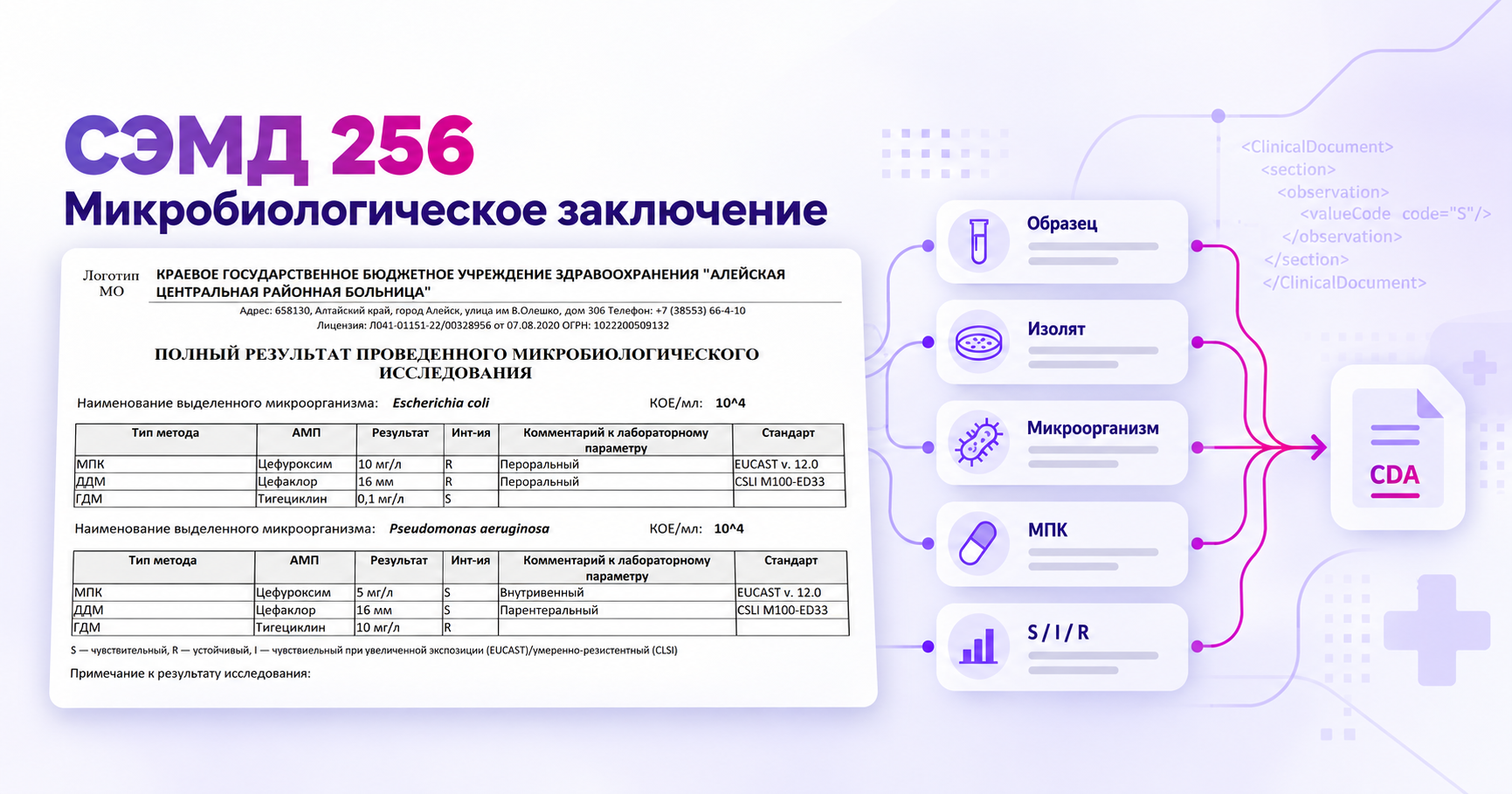
Table of Contents
Guide and implementation archive
- Official SEMD 256 implementation-guide page on the EGISZ portal
- Download the “Microbiology Investigation Report (CDA), edition 1” archive
The archive contains the implementation guide, explanatory documents, a template, an XML example, XSD schemas, Schematron, XPath/XSL files, and a change log. This local copy is provided for convenience; implementers should confirm the current edition on the official EGISZ page.
A microbiology result is normally read as a report: which material was examined, which microorganism was isolated, and to which antimicrobial agents it was susceptible. A computer system needs a more explicit model. It must distinguish the organism, isolate, method, quantitative result, interpretation, and the links between them.
A structured electronic medical document (SEMD) addresses this requirement. It combines a human-readable clinical document with standardized data that another information system can process unambiguously.
What SEMD means in practical terms
A PDF or a scan can be an electronic document without being a structured document. A line such as “Klebsiella pneumoniae, meropenem – R” is understandable to a person, but software still needs to know:
- which value identifies the microorganism;
- which biological material and isolate it belongs to;
- which antimicrobial agent was tested;
- which method produced the result;
- whether a quantitative result is present;
- which value is the measurement and which is its interpretation;
- which interpretation standard and version were used.
SEMD represents these elements separately and connects them. It is therefore a medical document for both people and information systems.
Which document is used for microbiology
Microbiology results are covered by the implementation guide titled “Microbiology Investigation Report”, also referred to in technical documentation as SEMD 256. It is based on HL7 CDA Release 2 and uses a highly structured representation of clinical data.
Microbiologists are not expected to author CDA or XML manually. The LIS or another medical information system should generate the technical document from the result validated by the specialist.
Structure of a microbiology SEMD
The core relationship can be summarized as:
patient → specimen → sample or isolate → microorganism → susceptibility test → result → interpretation
flowchart TD
    A[Patient and test order] --> B[Clinical specimen]
    B --> C[Sample or culture]
    C --> D[Isolate]
    D --> E[Microorganism identification]
    D --> F[Antimicrobial susceptibility testing]
    F --> G[MIC or inhibition-zone diameter]
    G --> H[S / I / R interpretation]
    I[Standard and version] --> H
    D --> J[Resistance markers]
    E --> K[Microbiology report]
    H --> K
    J --> K
The diagram highlights an important distinction: identification, quantitative measurement, interpretation, and resistance markers are separate but connected data. Their links preserve the clinical context of each isolate.
Document and patient context
The document contains administrative and clinical context, including the patient, healthcare organization, author, referral, and document identifiers. This provides the container for the microbiology result.
Specimen and isolate
The investigated material is represented as an identified object. Several cultures or isolates may be derived from the same specimen, and each can have its own identifier. This is essential when more than one organism is recovered.
Microorganism identification
The organism should not exist only as free text. A standardized code and display name allow receiving systems to recognize that variants such as Escherichia coli, E. coli, and uppercase spellings refer to the same organism.
How an antibiogram is represented
For each antimicrobial susceptibility test, the structured document can carry:
- the antimicrobial agent;
- the testing method;
- the quantitative result and unit;
- the categorical interpretation;
- the interpretation standard and version;
- the specimen or isolate to which the result belongs.
This turns a compact statement such as “meropenem – R” into a set of traceable, interoperable data elements.
Measurement and interpretation are different data
An MIC or inhibition-zone diameter is a measurement. S, I, or R is an interpretation assigned by applying defined criteria. Keeping them separate preserves the original laboratory result and makes later validation or re-interpretation possible when appropriate.
Linking susceptibility results to an isolate
Visual proximity in a printed report is not enough for data exchange. Identifiers establish the explicit chain:
specimen → culture or isolate → identified microorganism → susceptibility results
This prevents results from different organisms in the same specimen from being mixed during automated processing.
Antimicrobial resistance markers
The current microbiology SEMD structure supports a structured representation of antimicrobial resistance markers. Phenotypic susceptibility, quantitative AST values, and detected molecular markers can therefore remain connected within one document model.
Why SEMD matters for laboratories and AMR surveillance
Structured exchange reduces dependence on a particular LIS display or export format. Receiving systems can identify the organism, agent, MIC, interpretation, and context without extracting them again from narrative text.
This enables automated validation, cumulative antibiograms, local and regional AMR surveillance, analysis of resistance mechanisms, and clinical decision support. The quality of downstream analytics still depends on the completeness, coding, and clinical validity of the source result.
How SEMD relates to NSI dictionaries
The document structure defines where and how data are transmitted. Terminology and reference dictionaries define which standardized codes and values are used. Relevant dictionaries cover microorganisms, antimicrobial agents, test attributes, interpretation categories, standards, and resistance markers.
The OIDs and direct official links are collected in NSI dictionaries for antibiogram generation and health data exchange. An implementation should account for both the current SEMD edition and the versions of the referenced dictionaries.
What the clinician receives
Structured exchange does not require a clinician to read XML. The same data can be rendered as a familiar clinical report, while the underlying structure remains available to connected systems. The human-readable and machine-readable representations are complementary.
SEMD and EGISZ
SEMD forms part of electronic medical document exchange in the Russian healthcare information environment. General rules govern electronic medical records and document exchange, while the implementation guide for a specific SEMD defines the structure of that particular clinical document.
SEMD in ABioGram
ABioGram supports structured exchange of microbiology results. For AMR surveillance, SEMD is more than another import format: it preserves the chain from specimen and isolate to organism, antimicrobial agent, measurement, and interpretation. This reduces repeated transformation of laboratory data and provides a more reliable basis for automated analysis.
Key point
SEMD is not merely an XML file or an electronic copy of a paper form. Its purpose is to record medical information so that people and information systems interpret its meaning consistently.
Frequently asked questions
Is a PDF file a SEMD?
Not by itself. A PDF can be the visual representation of a report, while the standardized structured data are transmitted separately.
What is CDA?
CDA is an HL7 standard for representing clinical documents and their structured content.
Can an antibiogram and MIC be transmitted?
Yes. The antimicrobial agent, test method, quantitative result, unit, S/I/R category, and interpretation standard can be represented as separate elements.
Can results be linked to a specific isolate?
Yes. Specimen and isolate identifiers allow susceptibility results to be connected to the organism for which testing was performed.
Does SEMD support resistance markers?
The current microbiology SEMD structure supports structured antimicrobial resistance markers.
Must a microbiologist generate CDA or XML manually?
No. The information system should generate the technical document from the medical result entered and validated by the specialist.